Few cards make a heart skip like Death, so let this be said immediately: in tarot, Death is not a literal prediction, and readers do not treat it as one. It is the card of endings, transitions, and transformation, the honest acknowledgment that something has run its course and space is being cleared for what comes next. Death usually names something you already feel: a job that has quietly ended even though you still go to it, a relationship that has changed shape, a version of yourself you have outgrown. The card does not create the ending. It gives you permission to stop pretending the ending is not happening.
The Card's Imagery
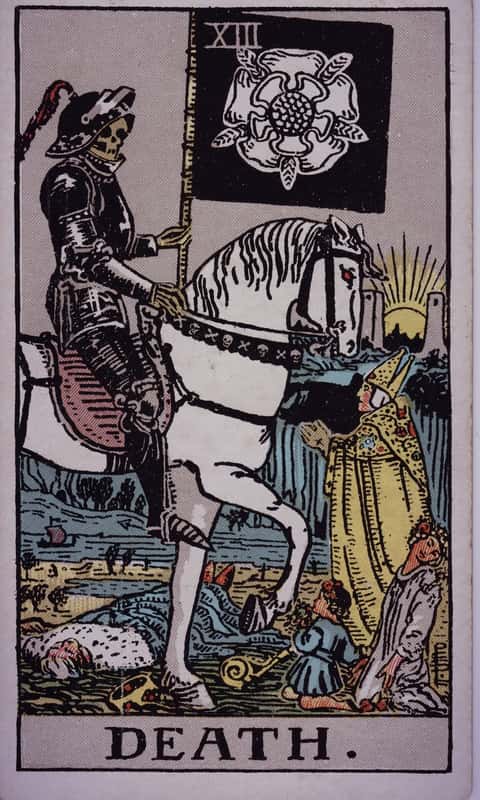
In the Rider Waite Smith deck, a skeletal knight in dark armor rides a white horse through a field where figures have fallen or kneel in its path. The image is stark, but look closely and it is far gentler than its reputation. The horse is white, the traditional color of purity and new beginnings, which quietly reframes the whole scene: what carries change forward is clean, not cruel. The figures in the field respond in different ways, some resisting, some pleading, some simply accepting, a small catalog of how humans meet endings.
On the horizon, a sun hangs between two towers, and the card leaves deliberately ambiguous whether it is setting or rising. That ambiguity is the card's whole philosophy in one detail: every ending, viewed from the other side, is a beginning. The skeleton itself is a symbol of what endures. When everything temporary is stripped away, the essential structure remains, and something true in you survives every chapter change.
Upright Meaning
Upright, Death speaks of endings, change, transformation, transition, and release. It rarely announces something you do not already sense. More often it confirms it: this phase is complete. That might be a role, a relationship dynamic, a belief about yourself, a long-running situation whose energy has simply finished. The card's invitation is to participate in the ending consciously rather than being dragged through it, to close the chapter with intention instead of letting it trail off.
Release is the keyword that makes this card livable. There is real grief in most endings, even the welcome ones, and Death makes room for that grief without treating it as a reason to stay. What it asks is honest sorting: what belongs to the closing chapter, and what comes with you? Where Death is a season of transition you can move through with some grace, The Tower is change arriving all at once; the two cards are neighbors in theme but very different in tempo.
Reversed Meaning
Reversed, Death usually means the transformation is real but stuck. Resistance to change is the classic reading: holding on to a situation, identity, or relationship past its natural season because the unknown feels worse than the discomfort of staying. The cost is usually a slow leak of energy. Nothing falls apart dramatically; things just stop growing, and life takes on a stale, waiting-room quality.
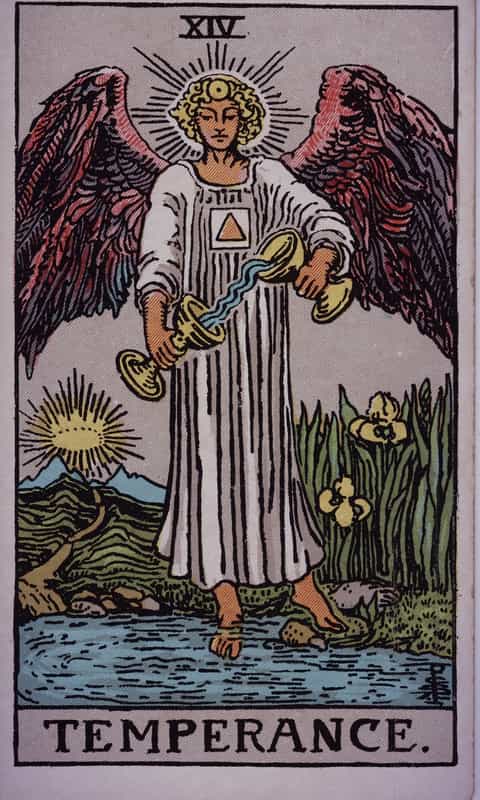
The reversal can also describe personal transformation delayed or driven inward, what some readers call inner purging. Outwardly, nothing has changed: same job, same routines, same commitments. Inwardly, an entire renovation is underway. Old beliefs are being dismantled, old identities composted, and the external life simply has not caught up yet. If that is your situation, the card offers reassurance: invisible change is still change. The reflective questions are gentle but pointed. What am I keeping alive artificially? What would I have to feel if I let it end? And is the safety of the familiar actually safety, or just familiarity? The art of moving through transition gradually, blending the old and the new without violence, belongs to Temperance, the card that follows Death in the major arcana.
In Love
In love, Death rarely means a relationship simply ends. More often it means the relationship as it has been is ending. For couples, it can mark the death of an old dynamic: the honeymoon script, an outdated division of roles, a pattern of conflict both people are finally done with. Relationships that survive this card often emerge more honest, because they were willing to let an old version of themselves go. Sometimes the card does accompany a genuine parting, and its counsel there is clean release: end what is over with respect, grieve it properly, and resist keeping it half alive.
For singles, Death often points to clearing the residue of a past relationship: the hope quietly maintained, the type repeatedly chosen, the story about yourself that dates back to an old heartbreak. Reversed, it can describe staying in something finished out of comfort or fear.
In Career and Money
Professionally, Death often accompanies the end of a role, a project, or an entire professional identity. It can surface when you have outgrown a job that once fit perfectly, or when an industry shift is retiring the old way of doing things. The invitation is to read the ending accurately and early. People who acknowledge a closing chapter get to plan their transition; people who deny it get transitioned anyway, with less choice. This card favors updating the resume, having the honest conversation, letting the old professional self be complete.
With money, Death suggests releasing what drains you, including commitments of money or energy kept alive only because ending them would mean admitting they did not work. Reversed, it can point to a needed financial change endlessly postponed. When an ending is fully accepted and its lessons integrated, the summing-up energy of Judgement is nearby: the honest life review that lets a new phase truly begin.
When This Card Keeps Appearing
If Death keeps appearing in your readings, something in your life is asking, repeatedly and patiently, to be released, and part of you keeps declining. Recurring Death is rarely subtle in retrospect: people usually know what it is pointing at, even when they say they do not. Treat the repetition as kindness rather than pressure; the card is keeping the truth on the table until you are ready to pick it up. Ask what ending you are negotiating with, and what one small act of release might look like this week.
Journal Prompts
- What in my life has already ended in truth but not yet in practice, and what keeps me maintaining it?
- If I trusted that something new would grow in the cleared space, what would I release first?
- Which past ending, painful at the time, do I now see made room for something I value? What does that teach me about the current one?
FAQ
Does the Death card mean someone is going to die?
No. In tarot practice, Death is read symbolically, not literally. It speaks to endings, transitions, and transformation, a chapter closing so that a new one has room to begin.
Is the Death card ever positive?
Very often, yes. Death marks the clearing away of what has run its course, which is frequently a relief. Many readers consider it one of the most honest and ultimately freeing cards in the deck.
What does Death reversed mean?
Reversed, Death often points to resistance to change or a transformation that is delayed or happening privately. It invites you to notice what you are holding onto past its season and why.
Get a Personal Reading
Death beside a love card, a work card, or The Tower tells three very different stories, and its meaning lives in that context. Pulled this card and want to know what it means in YOUR spread? Get your first personal reading for $1 and receive a warm, personal interpretation of your cards, your question, and the transition you are actually in.