The Emperor rarely shows up by accident. He tends to appear when some part of your life is asking for structure: a schedule that has dissolved, a boundary that keeps getting crossed, a dream that has plenty of passion but no scaffolding. When this card lands in a reading, you might feel a mix of relief and resistance, the way you do when someone finally says the organized, grown-up thing you have been avoiding. The Emperor is not here to scold you. He is here to remind you that stability is something you can build, and that you are allowed to be the authority in your own life.
The Card's Imagery
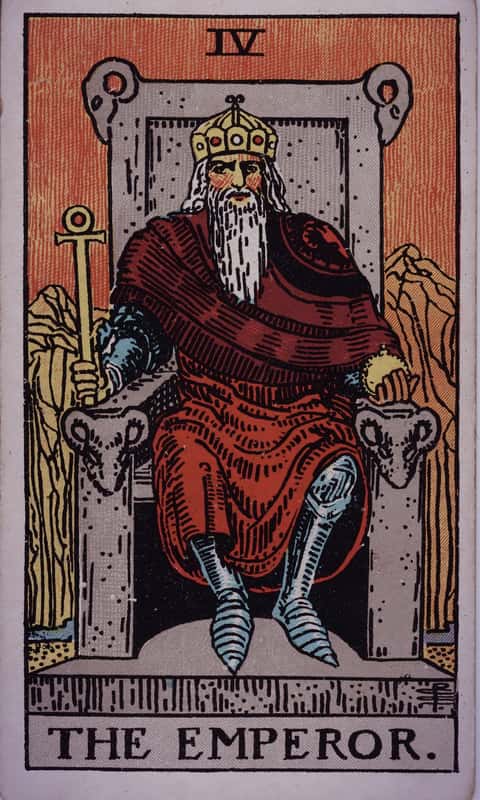
In the Rider Waite Smith deck, a stern figure sits on a stone throne adorned with ram heads, holding an ankh scepter in one hand and an orb in the other. Barren mountains rise behind him.
Every element speaks of endurance and order. The throne is stone, not cushioned: this is power built for the long term, unmoved by moods or weather. The ram heads connect him to Aries, the zodiac's initiating fire, suggesting that beneath the discipline sits real drive. The ankh scepter, an ancient symbol of life, hints that his authority exists to protect and sustain life rather than to dominate it, and the orb represents the realm he stewards.
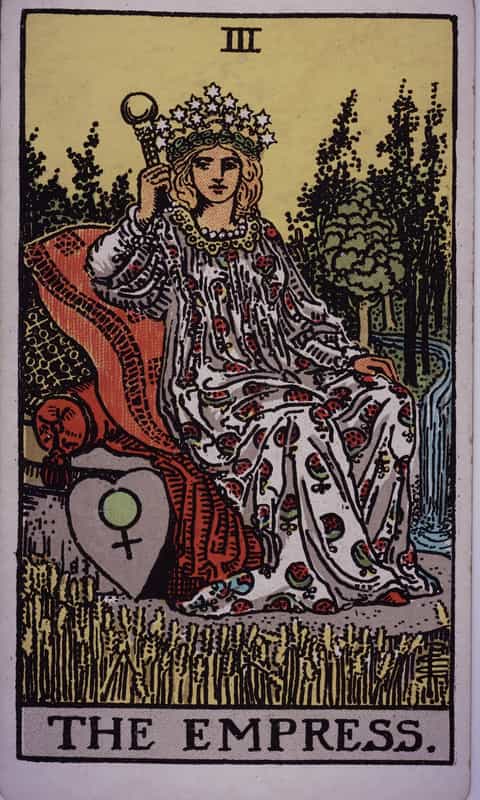
The mountains behind him are the most telling detail. They are bare and hard, the opposite of the wheat fields surrounding his counterpart, The Empress. Where she rules through growth and nurture, he rules through boundaries and law. The deck places them side by side for a reason: thriving usually requires both.
Upright Meaning
Upright, The Emperor stands for authority, establishment, structure, and the father figure. He is the energy of systems that work: budgets that balance, calendars that hold, promises that get kept.
When he appears upright, he often points to a moment where discipline serves you more than inspiration does. The idea phase is over; the building phase has begun. He invites you to define the rules of your own life deliberately: what time you start, what you say no to, what standards you hold. Structure, in his view, is not a cage. It is the trellis that lets the vine climb.
He can also represent a person: a father or father figure, a boss, a mentor, or any authority whose presence shapes your situation. Sometimes he is a role you are being asked to step into. Being the Emperor means taking responsibility without waiting for permission, protecting what you have built, and offering others the security of your consistency.
Reversed Meaning
Reversed, The Emperor turns toward domination, rigidity, inflexibility, and tyranny. Structure, overtightened, stops supporting life and starts strangling it.
Sometimes this reversal points outward, to a controlling boss, a domineering partner or parent, or an institution whose rules have stopped making sense. If someone's authority in your life runs on fear rather than trust, this card names that dynamic plainly.
Just as often, the tyrant is internal. A punishing inner critic, a schedule with no mercy in it, an inability to delegate, a need to control outcomes so complete that spontaneity has left the building. Rigidity can also look like refusing to update a plan that is clearly no longer working, simply because changing course feels like weakness.
The reversed Emperor invites a renegotiation with power. Rules should serve the people living under them, including when the ruler and the ruled are both you.
In Love
In love, the upright Emperor brings stability, protection, and commitment. For singles, he can point to an attraction to grounded, dependable partners, or to a season where you approach dating with more intention and self-respect: clear standards, honest pacing, no chaos for chaos's sake.
In relationships, he shows up as reliability. This is love expressed through acts of structure: showing up on time, handling the hard logistics, being the steady one in a storm. He is less flowery than romantic cards, but there is deep romance in someone you can genuinely lean on.
Reversed in love, watch for control wearing the mask of care. Rules about who a partner sees, spends, or becomes; affection that is conditional on obedience; or a relationship so scheduled and managed that play has vanished. He can also reflect emotional walls, a partner (or a self) so committed to strength that vulnerability feels forbidden. The invitation is to let fairness lead, an instinct this card shares with the clear-eyed balance of Justice.
In Career and Money
Career is The Emperor's natural arena. Upright, he favors leadership, promotion into responsibility, formalizing a business, and any move that adds structure: contracts over handshakes, systems over improvisation, documented plans over vibes. If you have been running your work life reactively, he suggests that a small amount of order (a real budget, a real calendar, a real strategy) could change everything.
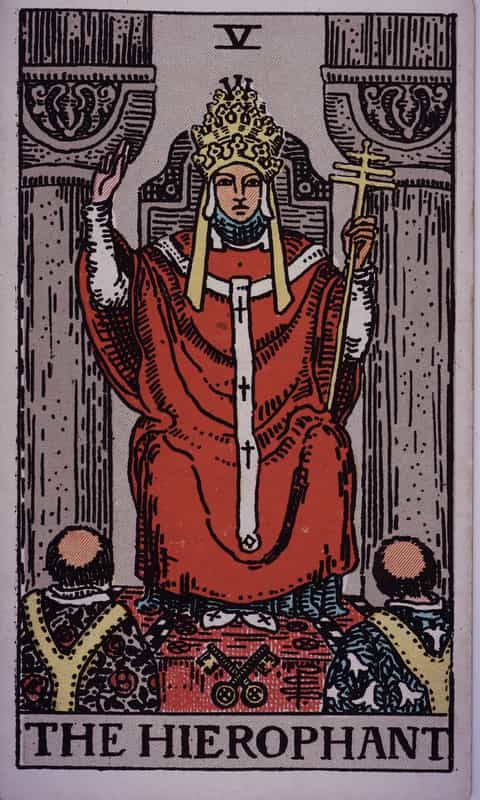
He also raises the question of your relationship with authority. Perhaps you are ready to become the boss, or perhaps you are learning to work well under one. Traditions and institutions have their own keeper in the deck, The Hierophant, and together these two cards ask how you relate to established systems: when to work within them, and when to build your own.
With money, The Emperor is conservative in the best sense: emergency funds, steady investments, long-term thinking. Reversed, he can point to micromanagement, inflexible business models, workplace power struggles, or financial control being used as leverage in a relationship.
When This Card Keeps Appearing
A recurring Emperor usually means your life is asking for a container. Look at where things feel chaotic: the finances you avoid, the boundary you state but never enforce, the project that stalls because it has no schedule. His repetition suggests that the missing ingredient is not more motivation or more information. It is structure, applied kindly and consistently.
Alternatively, if your life is already rigid, his repeated appearance may be holding up a mirror. Ask whether your rules still serve the life they were built for. Emperors who never revise their laws eventually rule empty kingdoms. Either way, the card returns until you consciously choose your relationship with order rather than defaulting into too little or too much.
Journal Prompts
- Where in my life do I most need structure right now, and what is one rule I could set and actually keep?
- Who taught me what authority looks like, and how does that model still shape how I lead or follow?
- Is there a boundary I keep stating but not enforcing, and what would enforcing it kindly look like?
FAQ
What does The Emperor mean in a tarot reading?
The Emperor points to structure, authority, and stability. He invites you to bring order to your situation, set boundaries, and take grounded responsibility for what you are building.
What does The Emperor reversed mean?
Reversed, The Emperor can reflect control taken too far: domination, rigidity, or tyranny, whether from someone in your life or from your own inner critic. It invites a softer, more flexible use of power.
Does The Emperor represent a person?
He can. The Emperor often reflects a father figure, boss, mentor, or any authority in your life, and sometimes the authoritative part of you. Read him in the context of your question and surrounding cards.
Get a Personal Reading
The Emperor beside a question about your boss means something very different than the Emperor beside a question about your own habits. Pulled this card and want to know what it means in YOUR spread? Get your first personal reading for $1 and receive a grounded, personal interpretation built around your exact question.